The European Union's ambitious Renovation Wave Strategy calls for doubling annual building renovation rates by 2030 to upgrade 35 million buildings, reduce emissions, and alleviate energy poverty. While advanced digital technologies like Artificial Intelligence (AI), the Internet of Things (IoT), and Digital Twins offer massive optimization potential, a major roadblock remains: the persistent gap between technical sophistication and real-world operational usability. Too often, technical services are developed in isolation, leading to misalignments with actual end-user constraints and daily operational realities. But not in LiveBetter!
In the LiveBetter project, to bridge this gap, we are involving six real-world European Business Cases directly, representing diverse stakeholder groups across the building value chain, from private tenants to municipal offices and financial institutions. The project does not develop these tools in a vacuum; instead, co-creation activities are an essential part of service development. Their feedback during the structured interviews and workshops is essential for improving the existing tools and methods into market ready services.
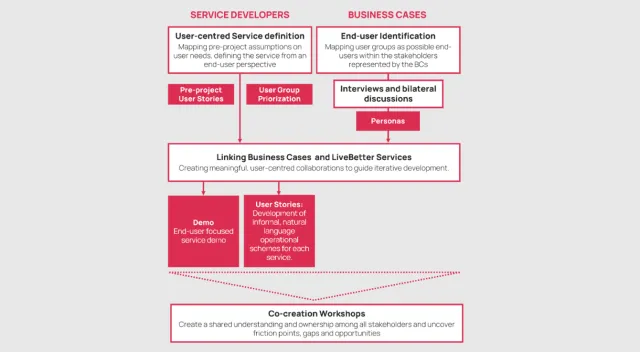
The first six months have been dedicated to setting the groundwork: co-creation activities led by ABUD with the support of UNIVPM, ICCS and MoS have concentrated on the collection of user stories and structured end-user feedback on the pre-project services to help refine the methodological framework. By utilizing 19 user personas - such as facility managers, energy auditors, and municipal planners – and inviting stakeholders from all business cases a series of workshops were facilitated, where service developers could gain systematic feedback of real-world needs, operational daily tasks, and structural barriers. This collaborative process generated 171 functional requirements, successfully shifting development from a purely technocratic exercise to a human-centric model. Results are being published in deliverable 5.1, and also been presented at the IEEE International Workshop on Metrology for Living Environment (MetroLivEnv 2026), held in Cambridge, United Kingdom.
Parallel to these activities, a survey was also launched to the general public, to gather feedback from stakeholders help identify gaps, barriers, and needs across Europe’s built environment through insights that will guide key upcoming activities.
Currently, the service developers are working hard on integrating the feedback into the new set of service prototypes. This fall, phase 2 of the co-creation activities will begin, concentrating on the user-centered tuning: experience-driven refinement and performance testing. Business case owners will gain hands on experience on the first versions of the upgraded LiveBetter services, focusing more the better usability and user-friendliness of the services, formulating and summarizing requirements on how to refine of UX and the end-user journey.
Through this co-creation framework, participants have already identified several critical, non-technical requirements necessary for these services to succeed in the market:
User Experience: The "Less is More" Philosophy
A primary piece of feedback from the co-creation workshops was that user interfaces must prioritize simplicity. Rather than overwhelming users with dense, chaotic dashboards, services should present a highly focused set of Key Performance Indicators (KPIs) tailored to specific roles. Municipal officers, bank auditors, and residential tenants have disparate levels of technical expertise; thus, services must provide role-specific, context-aware views to avoid information overload.
Minimizing Interaction Friction and Fatigue
For services that rely on occupant feedback, minimizing "user fatigue" is essential to prevent low participation. Participants specified that interfaces, such as thermal comfort voting apps, must be streamlined so that active input takes less than 10 seconds.
Retaining Human Control and Transparency
To foster trust in automated systems, end-users must not view AI as a "black box". Services must clearly explain background assumptions, input/output meanings, and underlying calculation methods. Crucially, participants emphasized that users prefer to retain override authority over automated interventions, such as system setpoint changes.
Speaking the Language of Finance
To motivate building owners and non-technical managers, services must translate technical data into economic value. Instead of only displaying efficiency gains in kilowatt-hours (kWh), systems must monetize energy savings.
Seamless Reporting and Compliance Alignment
A major administrative burden for building stakeholders is reporting. Workshop participants welcome one-click export functionalities to generate editable files (PDF, Word, Excel) directly compatible with banking software or stakeholder presentations. Furthermore, to secure green financing, service outputs must automatically align with standardized frameworks, such as verifying the 30% Primary Energy Demand (PED) reduction threshold required by the EU Taxonomy Regulation and ESG reporting schemes.
The first phase of the co-creation process in LiveBetter has been successful in setting groundwork for the enhanced services. The activities provided value far beyond the individual workshops. It aligns with the New European Bauhaus vision of steering societal transformation through the three values of sustainability, aesthetics, and inclusion, by ensuring that innovation is not only functional, but also environmentally responsible, experience-driven, and accessible. By engaging end-users, business case partners, and service developers throughout the development cycle, it enabled a deeper understanding of both practical and organizational needs that could not have been captured through pre-existing service documentation alone.
The LiveBetter project will continue to go on this path. Stay tuned!